

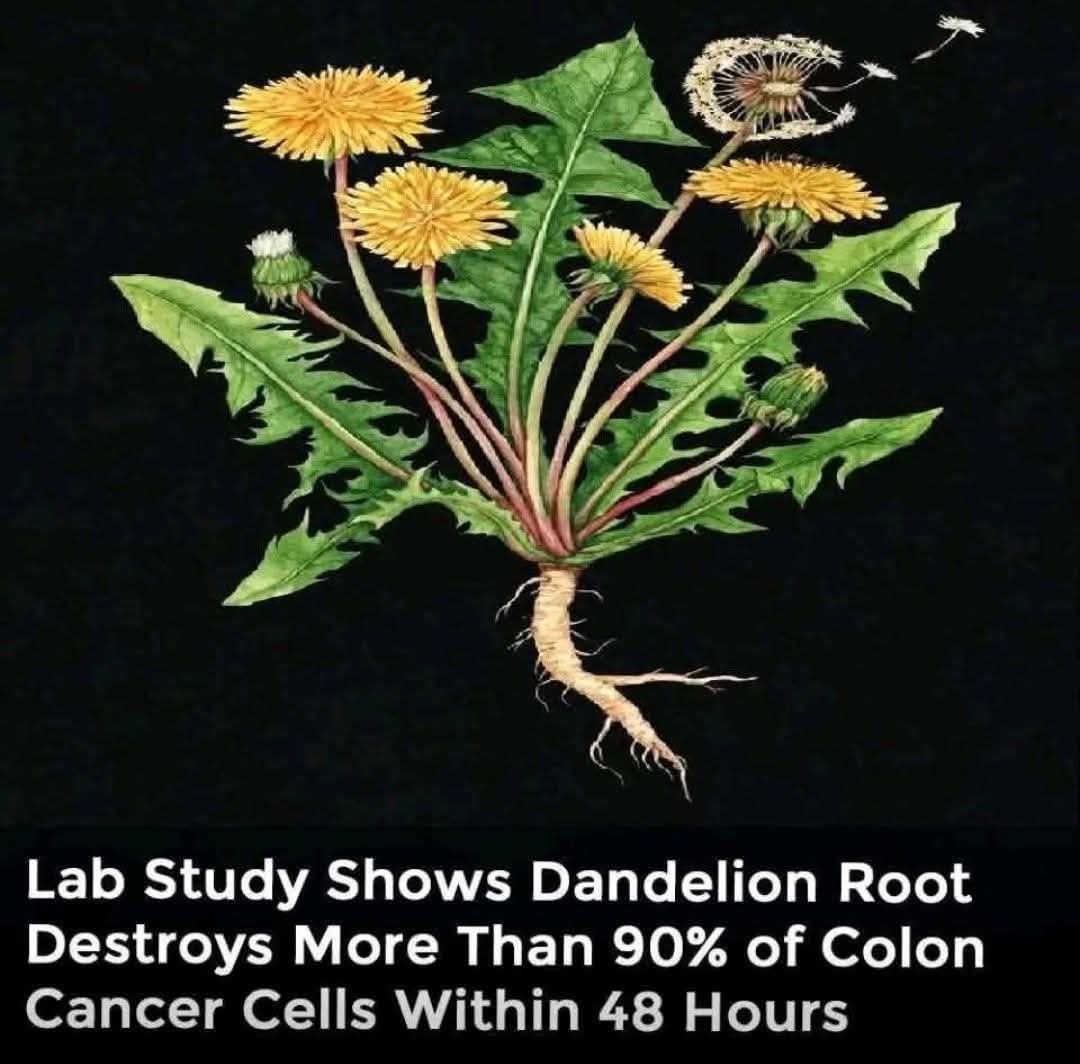
Here’s a more balanced, evidence‑based perspective on the claim “Lab Study Shows Dandelion Root Destroys More Than 90% of Colon Cancer Cells Within 48 Hours” — along with how such a “recipe” or extract might be prepared in lab/experimental settings. Important caution: this is not a medical recommendation — these are experimental results and preparations, not proven human therapies.
✅ What the scientific literature says
A study published in Oncotarget (2016) reported that an aqueous dandelion root extract (DRE) induced programmed cell death (apoptosis) in over 95% of colon cancer cell lines within 48 hours, regardless of p53 status (i.e. whether a key tumor suppressor gene is mutated or not).
In the same work, the researchers also tested in a mouse xenograft model (human colon cancer cells implanted into mice). They found that oral administration of the extract retarded tumor growth by more than 90% over the experimental period.
The extract appeared to activate multiple death pathways in the cancer cells (apoptosis, possibly caspase-dependent and caspase-independent mechanisms)
Importantly, the authors noted no significant toxicity in the mice over the experimental period, and the extract seemed selective for cancerous versus non‑cancerous colon cells in vitro.
However:
This data is preclinical (cell cultures + animal models). It does not mean the same effect will occur in humans, at safe doses, or with the same extract formulation.
The extract is a complex mixture (many phytochemicals: α‑amyrin, β‑amyrin, lupeol, taraxasterol, etc.). The synergy among compounds may contribute to effect.
Fact‑checking groups caution that such claims (“kills 90%+ cancer cells in 48 hours”) are often exaggerated or misrepresented in popular media.
Human clinical trials are lacking, so safety, dosing, side effects, interactions with other treatments remain unknown.
So, while the lab results are intriguing and promising, they are not proof that “dandelion root cures colon cancer” in people.
🧪 How researchers prepare a dandelion root extract for lab experiments
Below is a generic laboratory-style protocol for making a aqueous dandelion root extract similar (in concept) to what was used in the cited study. This is for experimental / research use, not for home medical use.
Disclaimer: This is for scientific or educational context. Do not assume that ingesting or applying such an extract as is will safely or effectively treat cancer in humans.
Materials & Reagents
Dried dandelion root (Taraxacum officinale) — cleaned, ground to fine powder
Distilled water (sterile)
Stirring apparatus / magnetic stir plate
Heating source (water bath, hot plate)
Filter paper or fine mesh / centrifuge
Rotary evaporator or freeze dryer (lyophilizer)
Cell culture media, cancer cell lines, etc. (for testing)
Sterile containers
Example Extraction Protocol
Weigh root powder
Use e.g. 10 g of powdered dandelion root.
Mix with water
Add to e.g. 100 mL distilled water (ratio often 1:10 w/v).
Heat / incubate
Heat gently (e.g. 60‑80 °C) and stir for 1–2 hours, or incubate at room temperature overnight with stirring. This yields an aqueous extract.
Cool & filter / centrifuge
After extraction, cool, then filter through filter paper or spin in centrifuge to remove solid particles.
Concentrate extract
Use a rotary evaporator (under reduced pressure) or freeze-dry (lyophilize) to remove water and yield a concentrated extract (powder or semi-solid).
Redissolve / sterilize
Re-dissolve in sterile water or buffer at desired concentration (e.g. 10 mg/mL). Sterile-filter (0.22 μm) before applying to cell cultures.
Apply to cell cultures
Add known concentration (e.g. in µg–mg per mL) to cancer cell lines, incubate 24–48 hours, measure viability, apoptosis assays, etc.
In vivo studies
For animal models, dosing is based on mg extract per kg body weight; administered orally or by other routes; monitor tumor size, animal health.
⚠️ Important caveats & safety considerations
The effective concentrations used in vitro may be much higher than what can be safely or practically achieved in humans.
Many compounds behave differently in a living body (absorption, metabolism, distribution, excretion).
Extracts can interact with drugs (chemotherapy, immunotherapy, etc.) in unpredictable ways.
Without controlled human trials, we cannot know safe dosage, toxicity, or side effects.
Claims on social media about “tea cures cancer” often conflate the lab extract study with drinking dandelion tea, which is not the same. Fact-checkers warn these claims are misleading.